Why foreign SaaS breaks for Indian small businesses
Soham Singh
Co-Founder & Engineer
Last verified: October 2026.
Key takeaways
- •GST has to be part of the invoice logic, not a tax-rate setting.
- •Payments need UPI and Indian cards that actually work for recurring billing.
- •Customers and owners expect to be reached on WhatsApp.
- •Dollar-style pricing feels different to a small Indian buyer.
- •Phone, name and address fields built for other countries reject real customers.
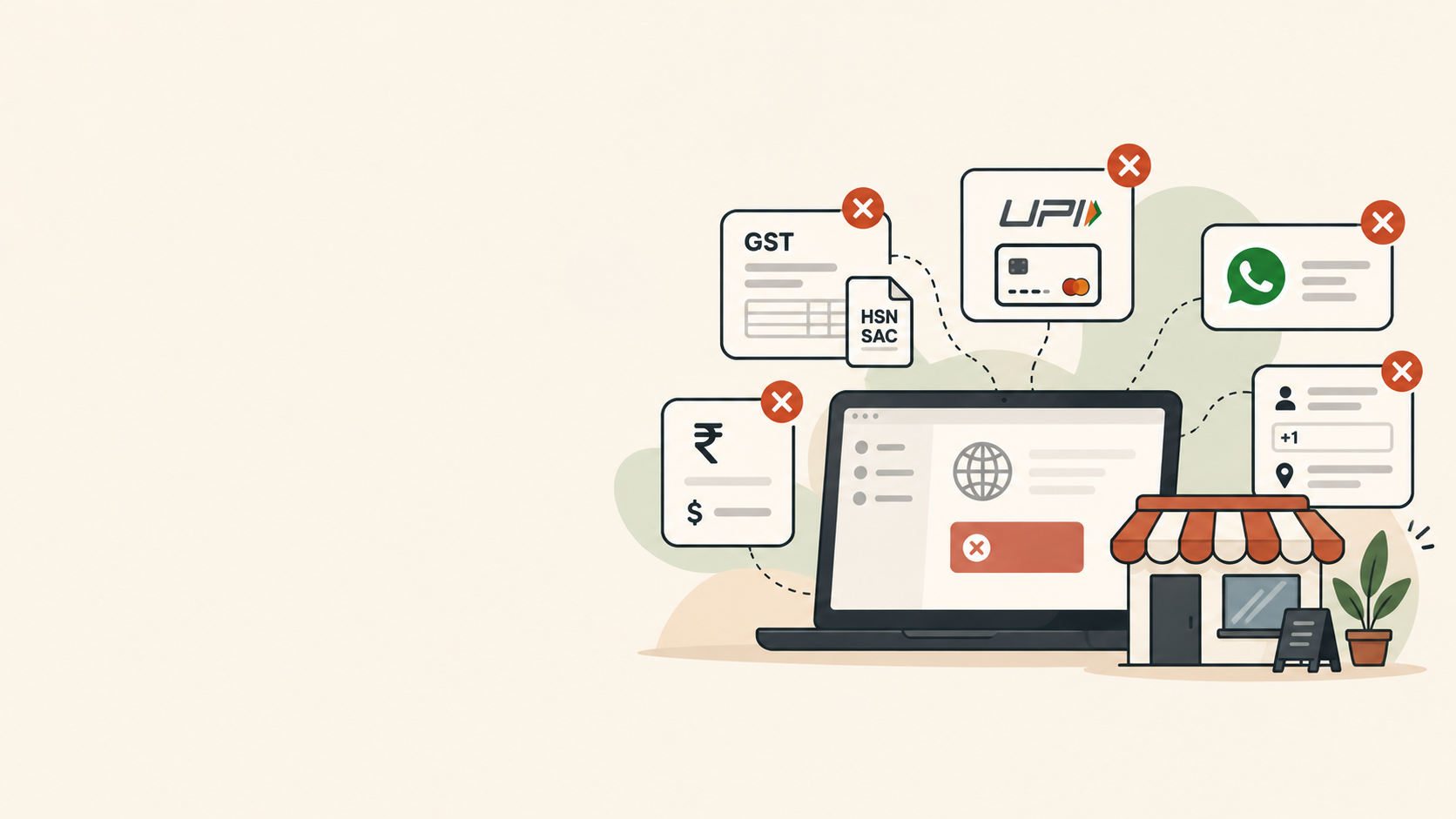
Software built for a US or European market tends to fail Indian small businesses on five things: GST-compliant invoicing, UPI and local payments, WhatsApp as the main communication channel, rupee-friendly pricing, and local data formats. Each one looks small, but together they decide whether a business keeps using the tool past the trial.
1. GST is not a tax setting
In many foreign tools, tax is a single percentage. Indian invoices need more. Guides explain that HSN codes apply to goods and SAC codes to services, and the tax splits into CGST, SGST or IGST depending on where the transaction happens. In practice that means the tool must know the seller’s and buyer’s states to decide between CGST+SGST and IGST. It also needs GSTIN fields, and invoice numbering that follows Indian rules (the GST rules limit invoice numbers to 16 characters, so check current requirements). Source: getswipe.
Larger businesses also face e-invoicing requirements above a turnover threshold, which has changed over time. If your customers are bigger than a small shop, confirm the current threshold.
A vendor blog on this topic argues that Indian buyers expect GST to be built in rather than treated as a bolt-on. That’s a vendor’s view, but it matches what the invoice rules require. Source: mewayz.
2. Payments: UPI and recurring billing
Indian customers expect to pay by UPI. For subscriptions, recurring charges on Indian cards follow RBI rules that can require extra authentication and mandates, and cards sometimes fail on international merchants. A product billed in dollars through a foreign gateway can end up with avoidable payment failures. Using an Indian gateway such as Razorpay, and supporting UPI, usually fixes this, but check the current mandate limits and rules.
3. WhatsApp is the channel
Orders, questions and support often happen on WhatsApp, not email. Tally says Indian MSMEs use automated WhatsApp invoicing to send invoices and collect payments. A tool that only emails invoices and reminders can feel slow by comparison. If you support WhatsApp delivery, remember it runs on the API with its own approval and costs (see our post on the approval process). Source: tallysolutions.
4. Pricing in rupees
A price that looks normal in dollars can feel heavy to a small business owner paying in rupees. One vendor blog frames a ₹3,999 monthly price as something that has to be visibly worth its rupees. Whatever you charge, show it in INR, include GST clearly, and let people start small. Source: mewayz.
5. Small data details that break forms
One source lists examples such as +91 phone formats with ten digits, and names with multiple surnames or only a single name (mewayz). Add to that:
- Six-digit PIN codes and state selection tied to GST.
- Number grouping like 1,00,000 (lakh) instead of 100,000.
- April to March financial years instead of January to December.
- Addresses without a clean 'street, city, ZIP' structure.
When custom software makes sense
Off-the-shelf options exist, and GetApp lists 14 billing tools with WhatsApp support as of July 2026. Custom software makes sense when your workflow is unusual, you need specific integrations, or you want to own the system. If a standard GST tool already fits, buy it. Source: getswipe.